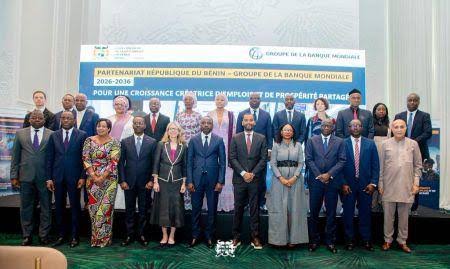
The Benin and the World Bank are changing gears in their cooperation. The two partners launched on Friday in Cotonou a partnership framework of $2.6 billion (about CFAF 1,446 billion) covering the period 2027-2036, with a clear ambition: to make job creation the main driver of the next decade of growth. Adopted on June 16 in Washington, it is the first decade-long partnership concluded between the country and the Bretton Woods institution.
The launch of this new strategic framework was marked by the signing of $320 million in new funding. An envelope of $150 million is earmarked for the first phase of the Dogo-Bis hydroelectric dam, while $170 million will finance a program dedicated to infant nutrition, combining infrastructure investments and human capital strengthening.
Beyond the funding, the World Bank aims to accompany a deeper transformation of the Beninese economic model. The partnership is based on three priorities: developing a better-trained and healthier workforce, strengthening infrastructure, and accelerating growth driven by the private sector. The goal is to convert the country's macroeconomic performance into productive and sustainable jobs.
The challenge remains considerable. According to the resident representative of the World Bank, Karine Bachongy, Benin will have to create 250,000 jobs per year to absorb young people entering the labor market. However, despite sustained growth, the economy still struggles to generate enough formal jobs. In 2025, 80% of new jobs created were still in the informal sector, limiting productivity gains and fiscal revenues.
Nevertheless, the economic fundamentals remain solid. Benin, classified since 2020 among the lower-middle-income countries, recorded an average growth rate of 6.9% between 2021 and 2025, before reaching 8.1% in 2025. At the same time, the extreme poverty rate fell from 26.4% in 2021 to 20.5% in 2025.
Through this long-term partnership, the government and the World Bank now have a priority: to make this economic dynamic a lever for industrialization, strengthening of the private sector, and massive job creation, in order to transform growth into sustainable prosperity.
Comments 0
You must be a member to add a comment.
Already a member? Sign in
Not a member yet? Become a member for free
No comments on this article yet.